Page Title
 | Date of Patent: Sep. 4, 2018 | |
| Issued by: United States Patent and Trademark Office |
| Title: TUBULAR CONNECTION ASSEMBLY FOR IMPROVED FATIGUE PERFORMANCE OF | |
| METALLIC RISERS |
| Description: A flared and thickened tubular end assembly to improve the fatigue | |
| performance and increase the fatigue life of tubular connections subjected to cyclic loading such as connections encountered in but not limited to offshore steel catenary risers (SCRs) and steel lazy wave risers (SLWRs) |
| EPC (European Patent Convention) Patent: Approved, Number Pending |
BENEFITS
| Overcomes the limitation of traditional upset ends imposed by increasing the wall | |
| thickness only (keeping the same internal diameter of the pipe) vis-à-vis welding |
| Eliminates weld qualification of excessive wall thickness using traditional upset ends | |
| and associated risk, time, and cost |
| Reduces offshore welding time and cost |
| Provides an alternative to using costlier materials such as titanium |
| Provides an alternative to using non-established connections for steel catenary risers | |
| (SCRs) and steel lazy wave risers (SLWR) such as flanged or threaded connections |
BENEFITS COMPARED TO STEEL LAZY WAVE RISERS (SLWRS)
| Significantly simpler to analyze and design—eliminates the effort and time required to | |
| establish the proper configuration of SLWRs and changes in configuration as a function of contents and floater offsets |
| Eliminate the high cost of buoyancy modules (several million US dollars), installation | |
| complexity, limitation on choice of installation methods and vessels, and associated cost impact |
| No gaps in strakes in the "hog bend" section of the riser (section with buoyancy | |
| modules) |
| Better short- and long-term integrity—no buoyancy modules to worry about especially | |
| for insulated risers and straked risers |
| Eliminate the environmental impact of buoyancy modules’ fabrication and disposal |
FABRICATION
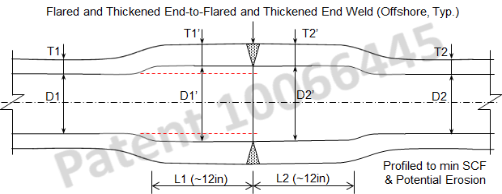
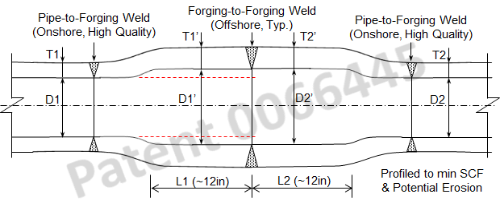
| Can be fabricated either as a separate forging or integral with the pipe |
| Fabrication as separate forgings requires WPQ, fatigue testing, and AUT | |
| qualification/validation of the |
| Pipe-to-forging welds | |
| Forging-to-forging welds |
| Fabrication integral with the pipe requires WPQ, fatigue testing, and AUT | |
| qualification/validation of the |
| Flared and Thickened End-to-Flared and Thickened End welds | |
| This would likely eliminate the WPQ, fatigue testing, and AUT | |
| qualification/validation of the SCR pipe welds—would definitely eliminate it for thickness of the integral flared and thickened ends within certain code limits of the SCR pipe thickness |
EXAMPLE
In this example, the SCR pipe is 7.25in ID X 1.75in WT. The fatigue life is low and flared and
thickened ends are needed to provide a factor of 4 in order to meet the design life.
| Keeping the same pipe ID (traditional upset ends) requires a 7.25in ID X 2.3in | |
| WT upset end--this thickness is excessive vis-à-vis welding | ||
| Keeping the same pipe wall thickness requires an 8.997in ID X 1.75in WT flared | |
| end--this increase in ID is probably excessive | ||
| Alternative Flared and Thickened Ends are |
| 8.469in ID X 1.90in WT--this increase in ID is more reasonable | |
| 8.139in ID X 2.00in WT--this increase in ID is yet more reasonable and | |
| the increase in WT is also reasonable vis-à-vis welding |
| Other Flared and Thickened End configurations are also possible as desired |
FLOW VELOCITY
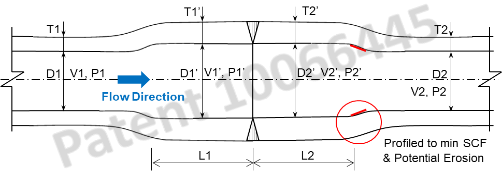
| Q = V1 * A1 = V1’ * A1’ => V1’ = V1 * (A1/A1’) = V1 * (D1/D1’)^2 | |
| I.e. as the diameter increases, the velocity decreases |
| Example |
| SCR pipe: 7.25in ID X 1.75in WT | |
| Flared & Thickened Ends: 8.139in ID X 2.00in WT | |
| V1’ = 0.79 V1 |
FLOW PRESSURE
| P1 + ρ g h1 + ½ ρ V1^2 = P1’ + ρ g h1’ + ½ ρ V1’^2 (Bernoulli’s Eqn.) => | |
| P1’ = P1 + ρ g (h1 – h1’) + ½ ρ (V1^2 - V1’^2) | |
| I.e. as the diameter increases, the pressure increases |
| Example |
| SCR pipe: 7.25in ID X 1.75in WT | |
| Flared & Thickened Ends: 8.139in ID X 2.00in WT | |
| ρ = 1.71 lb.sec^2/ft^4 (55 pcf oil) | |
| P1 = 10 ksi | |
| h1 – h1’ = ~ 2.5ft Length of Flared & Thickened Ends | |
| V1 = 11.33 ft/sec (corresponds to production of 50 Mbbpd) | |
| V1’ = 8.95 ft/sec | |
| P1’ = 10.0012ksi |
POTENTIAL EROSION
| Potential Erosion on Transition from Flared & Thickened Ends-to-Pipe | |
| From DNVGL-RP-O501 |
| Example |
| SCR pipe: 7.25in ID X 1.75in WT | |
| Flared & Thickened Ends: 8.139in ID X 2.00in WT | |
| ρm = 881 kg/m^3 (55 pcf Oil) | |
| ρt = 7800 kg/m^3 (487 pcf , Steel pipe) | |
| P1 = 10 ksi | |
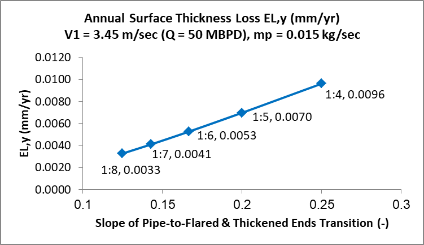
| V1 = 11.33 ft/sec (3.45 m/sec, corresponds to production of 50 Mbpd) | |
| V1’ = 8.95 ft/sec (2.73 m/sec), V1 is used conservatively | |
| mp = 0.015 kg/sec (0.033 lb/sec, Mass rate of sand) | |
| dp = 0.0005 m (0.5mm, ~20 mils, Sand particle diameter) | |
| As Velocity increases, measures to control mass rate of sand increase | |
| The transition thickness can be increased to accommodate potential | |
| erosion (e.g. 0.29mm for 30-yr riser life and 1:4 transition slope) | ||
| Erosion is not an issue for export SCRs | |
| CFD analysis can be performed for better prediction of potential erosion | |
PATENTS
ARTIFEX ENGINEERING, INC. HAS THE FOLLOWING PATENT